
Waste Streams After Concrete Cutting: How Disposal Choices Affect Cost, Schedule, and Compliance
On paper, “remove the concrete” sounds like a single line item. On live sites, it’s a logistics system: what stream you generate, where it’s allowed to go, how heavy it is, and what the facility will tolerate (noise, dust, slurry, route cleanliness).
This article breaks down the real waste streams that follow diamond cutting (wire, wall, floor, coring), and how disposal choices change:
- Cost (tipping fees, overweight charges, extra handling)
- Schedule (bin swaps, lane permits, rejected loads)
- Compliance (site separation rules, documentation, contamination)
1) The physics that drives everything: concrete is heavy
Most planning mistakes come from underestimating weight.
Normal-weight concrete is commonly around 150 lb/ft³ (~2,400 kg/m³).
That means even “small” sections get heavy fast:
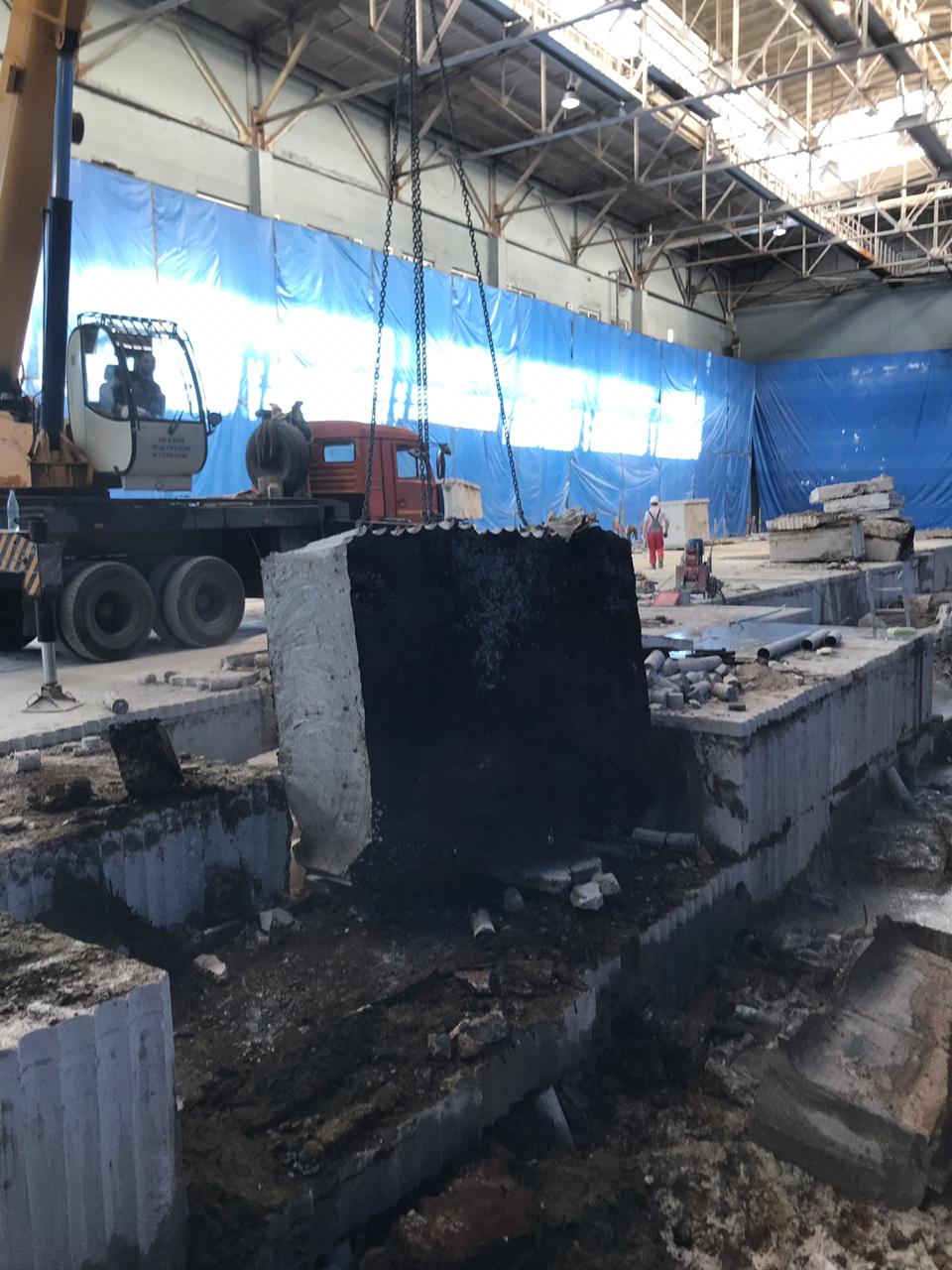
- Example segment (airport foundations): 2 ft × 3 ft × 2 ft thick
Volume = 12 ft³ → Weight ≈ 1,800 lb (~0.82 t) (before “extra” steel)
12 segments ≈ ~9.8 t total concrete mass moved through the building.
This is why “we’ll just carry it out” fails in real mechanical rooms.
2) Your real waste-stream map (what actually leaves the site)
Based on typical indoor cutting + controlled removal jobs, these are the streams that matter:
A) Reinforced concrete (RC) — most common
Concrete with mesh/rebar/fiber. This is the default output on most ICI work.
Typical path: concrete recycling / aggregate processing. Many recycling operations remove rebar using magnets during processing.
Key validation: confirm the receiving facility’s acceptance rules for:
- oversized pieces,
- contaminants (tile/brick/wood),
- unusual embedded steel.
B) “Heavy steel inside” concrete — less frequent, high-risk
Examples: steel plates, rails, vault linings, unusual embedded metal.
This can trigger:
- slower cutting,
- higher tool wear,
- stricter acceptance rules at recycling sites.
PM takeaway: treat it as a separate stream until the recycler confirms acceptance.
C) Slurry solids (buckets) — periodic
Indoor wire/wall/floor sawing produces slurry. On many sites:
- liquid water may be allowed to drain (with permission),
- solids must be captured and removed.
Typical handling: bucketed solids → covered/secured → into concrete bin for disposal/recycling (if permitted by the facility).
D) Cores (from coring) — periodic
Cores are usually “concrete” from a disposal standpoint, but they create two issues:
- trip hazards / cleanliness if left on site,
- surprise weight if someone stacks them in one area.
E) Packaging / consumables — low volume, always present
Plastic, tape, pails, worn wire, used blades, wrap. Usually goes to general construction waste unless a site requires separation.
F) Mixed debris — rare (if you do interior demo too)
If interior demo is part of scope, mixed C&D appears. The best practice is not mixing it into concrete loads, because contamination can cause rejection or higher tipping.
3) Why disposal choices change cost
3.1 Tipping fees: “inert” vs “garbage” is a different price universe
Even within the GTA/Ontario region, published rates vary significantly by facility and by material classification (inert/clean fill vs garbage/mixed). For example, different municipal/regional facilities publish different per-tonne rates for loads classified as waste/inert materials.
What drives cost up:
- load reclassified from “concrete/inert” to “garbage/mixed”
- contamination (tile/brick/wood)
- oversized pieces (facility can’t process without extra breaking)
- overweight loads
3.2 Bin size is not just volume — it’s legal weight
Concrete bins are often smaller by design (e.g., 14-yard) because trucks hit weight limits before filling larger containers.
Many bin providers structure concrete bins with an included tonnage (often ~2–3 metric tonnes) before overweight charges.
So “one more section” can create a surprise line item if it pushes the bin over the included weight.
4) Why disposal choices change schedule
4.1 Rejected or redirected loads happen
You described a real-world scenario: a recycler flagged a load (radiation screening) and redirected it. That’s not fantasy—portal monitors are used in multiple industries, including waste/recycling contexts, to detect radioactive sources in incoming loads.
Schedule impact: if a load is rejected or must be rerouted, you burn:
- truck time,
- driver time,
- bin swap windows,
- possibly night-window access.
4.2 Downtown logistics: bins and generators may require permissions
If bins (or support equipment) occupy public right-of-way, you’re in permit territory. The City of Toronto explicitly ties placing bins/containers on the right-of-way to street occupation / right-of-way permitting requirements.
Schedule risk: no permit → bin can’t be placed where planned → haul-out route breaks → more manual handling.
5) Compliance: what PMs must validate (and why “it’s just concrete” is wrong)
Many ICI sites operate under waste-audit / source-separation expectations. Ontario’s IC&I framework includes requirements for waste audits and source separation programs in designated sectors (site rules often reflect these obligations).
Practical meaning for PMs:
- The site may require separation by stream (concrete vs general).
- Contamination can trigger non-compliance, rework, or rejection.
- Documentation may be requested even if it wasn’t on the first job.
6) The PM validation checklist (what breaks the plan in the real world)
If you want end-to-end removal to run without drama, validate these early:
6.1 Route & access (the top 3 bottlenecks)
- Door width (most common limiter): 32" / 36" / 42" changes everything.
- Elevator capacity (labels like ~1,500 lb show up often): forces smaller segments or different equipment strategy.
- Basement stair geometry: steep/acute stairs can make a skid steer/mini loader unsafe or impossible.
6.2 Where the bin can physically go
- Is there a clean placement area on private property?
- If not, who handles right-of-way permissions?
- Which bin size is feasible (14 / 20 / 40 yd) based on weight and access?
6.3 Segment sizing rules (weight + handling + floor limits)
A practical segmentation logic is:
- Manual carry / tight corridors: 20–30 kg pieces
- Pallet jack / dollies: ~300–750 kg segments
- Chain hoist / overhead crane: ~1,000–1,500 kg segments (if rated & verified)
- Open site + proper lifting plan: larger sections may be possible
And two “floor protection” rules that prevent surprises:
- Don’t stockpile heavy pieces in one spot (spread loads).
- Confirm slab/structure limits if you’re on older framing or sensitive floors.
6.4 Cleanliness standard (inspection-ready reality)
On indoor jobs, the most common “inspection eyes” are:
- Safety officer (PPE, cords, housekeeping),
- building management (damage, cleanliness),
- GC superintendent (sequence, readiness for following trades).
What they notice first:
- slip hazards (wet slurry paths),
- trip hazards (cores/sections left in traffic areas),
- cord safety (no damaged cables or taped splices),
- containment discipline (wet mess outside the work zone).
7) Three field snapshots (how waste-stream choices change the job)
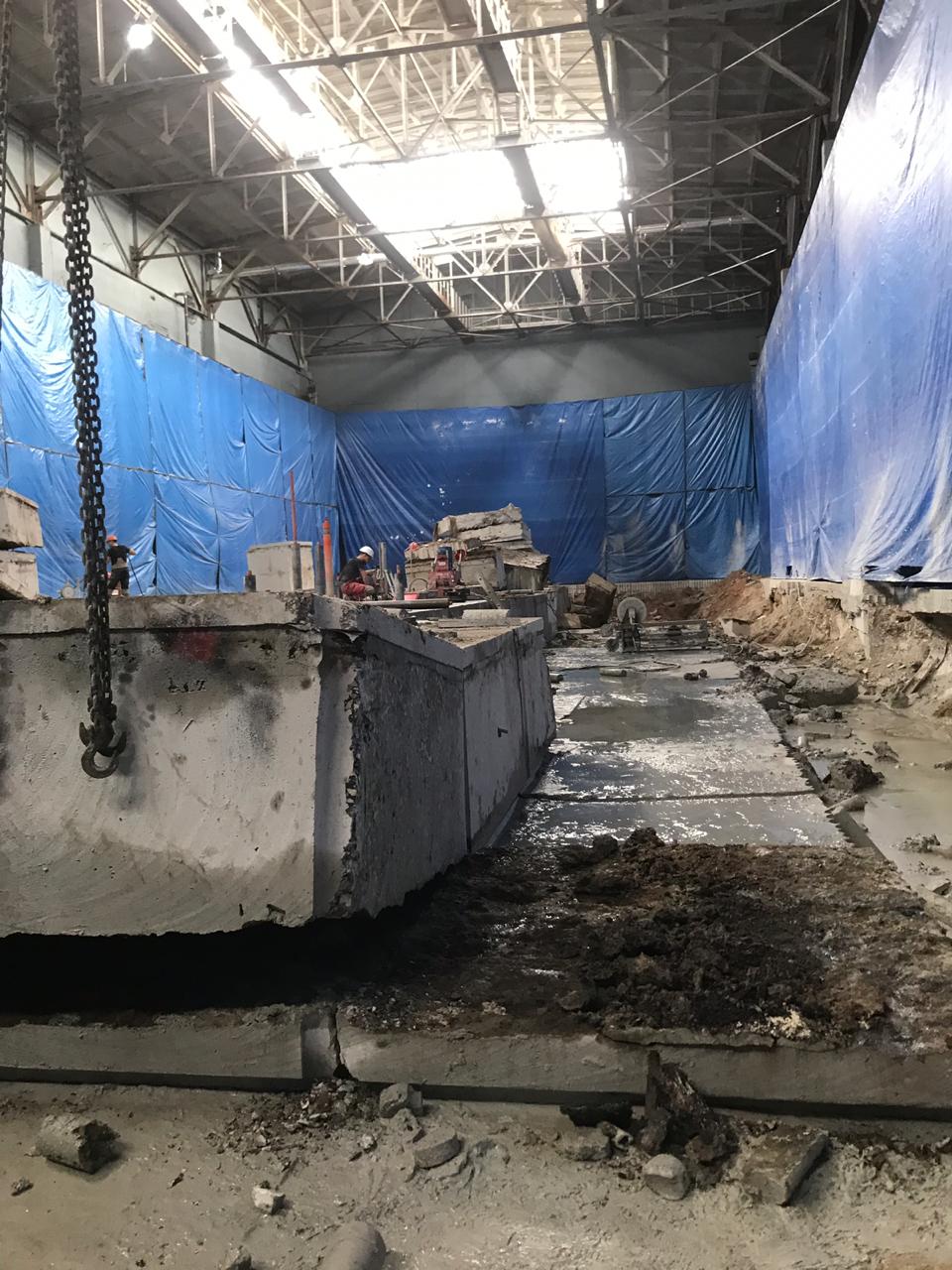
Snapshot 1 — Airport mechanical room (thick foundations, no vibration tolerance)
- Scope: 3 foundations, ~24" thick, wire-sawn into 2×3×2 ft blocks
- Output: 12 heavy sections (~1,800 lb each) + slurry management
- Waste-stream issue: reinforced concrete + embedded steel risk → confirm recycler acceptance
- Planning key: route (36" doors + elevator + corridors) and no staging pile-ups
Snapshot 2 — 100 Jameson Ave, Toronto (large slab removal, tight logistics)
- Scale: 6,000 ft² at ~8" thickness is hundreds of tonnes of concrete by density math
- Why it mattered: the bottleneck wasn’t cutting—it was haul-out staging and truck/bin positioning
- Waste-stream issue: high-volume RC → bin swaps + avoiding contamination becomes schedule-critical
Snapshot 3 — Retail overnight trenching (Food Basics, Ottawa)
- Constraint: work after close, deliver clean/ready floor for opening
- Waste streams: small concrete, controlled slurry, packaging
- Planning key: night-window execution system (route protection + immediate cleanup) rather than shutdown planning
8) What to put in the scope notes (to avoid “surprise disposal”)
When you write or review the scope, make sure these are explicitly answered:
- Which waste streams are included? (RC, slurry buckets, cores, packaging)
- Who supplies bins and permits? (GC/owner vs contractor)
- Where can the bin be placed? (private property vs right-of-way)
- Are scale tickets required? (often “not required”… until they are)
- Any restrictions on draining water? (site-specific, get it in writing)
Waste Streams & Disposal After Concrete Cutting (GTA)
PMs planning concrete removal after cutting—bins, recycling rules, slurry handling, and compliance checks.