
Silica Dust Control for Indoor Concrete Cutting: Wet Cutting Isn’t Enough-Here’s the Full System
Indoor concrete cutting is often sold as “wet cutting = no dust.” In reality, indoor dust control is a system, not a single tactic.
Yes-wet cutting reduces airborne dust at the blade. But respirable crystalline silica (RCS) risk spikes indoors when you add the real jobsite variables: tight rooms, people nearby, sensitive equipment, short windows, and cleanup under pressure.
This is the framework we use on live sites across GTA/Ontario daily, and Canada-wide for wire sawing scopes:
Plan → Control the source → Control migration → Control cleanup → Control slurry → Verify.
1) The compliance reality: numbers matter, but the workflow matters more
Most owners don’t ask you to “hit a μg/m³ number” at bid time. They ask for outcomes:
- no dust migrating into occupied zones
- no alarms triggered
- no contamination (food / sensitive interiors)
- clean turnover before reopening
But the exposure benchmarks behind those requirements are real. OSHA defines an Action Level (25 μg/m³) and PEL (50 μg/m³) as 8-hour time-weighted averages.
In Ontario-focused construction guidance, the commonly referenced 8-hour limits are 0.1 mg/m³ for quartz/tripoli and 0.05 mg/m³ for cristobalite.
Key estimator takeaway: indoor “dust control” isn’t just about the saw. It’s about the entire shift workflow—especially the last hour (cleanup, removal, reset).
2) Why wet cutting isn’t enough indoors (the predictable failure modes)
Wet cutting reduces dust at the cut line. But indoor dust issues show up when:
A) Chipping enters the scope (even minor)
Chipping is the #1 generator of “unexpected dust tails” indoors—because it’s often done quickly, locally, and without the same discipline as the main cut.
B) Slurry dries and turns into dust later
If slurry dries on the floor, on walls, or in corners, it becomes future dust when disturbed by:
- foot traffic
- dollies/pallet jacks
- cleanup scraping
- trades coming in after you
C) “Wet” is inconsistent
Small failures create big indoor issues:
- water feed not continuous
- poor nozzle position
- splash/mist off vertical wall cuts
- inadequate capture at the bottom of a wall cut (slurry spread)
D) Cleanup uses the wrong method
Dry sweeping and dry scraping re-aerosolize fine particles. Indoors, you need a plan that assumes:
cleanup is part of exposure control.
E) Containment is missing when occupancy demands it
Even if the cut itself is controlled, dust migration happens through:
- door gaps
- corridors
- HVAC pathways
- repeated entry/exit
3) The full indoor silica control system (the “stack”)
We use a layered system aligned with the hierarchy of controls (practical, site-buildable):
3.1 Pre-task planning (where most dust is prevented)
A proper plan answers:
- What stays occupied? What becomes the controlled zone?
- Where does traffic move during the shift?
- Where will slurry collect, and how will it be captured?
- What is the turnover standard (construction-clean vs operations-clean)?
- What tasks introduce dry disturbance risk (chipping / touch-ups)?
Deliverable mindset: an estimator should be able to summarize the plan as:
“Cut method + containment + cleanup + slurry disposal + turnover.”
3.2 Wet cutting—done correctly
Wet cutting isn’t “turn on water.” Indoors, it’s:
- continuous feed to the blade/cable
- stable delivery (no stop-start)
- disciplined control of splash and spread
- immediate collection so slurry doesn’t become a future dust source
OSHA’s Table 1 approach illustrates this principle: for several saw/drill tasks, the specified method is an integrated water delivery system that continuously feeds water to the cutting surface—especially important when used indoors or in enclosed areas.
Our operating ranges (for planning):
- Wire sawing (indoors): ~1.0–1.5 m³ of water per shift (high-volume work)
- Wall/Floor sawing: ~0.5–1.0 m³ per shift depending on length, containment, and housekeeping standard
3.3 Capture and housekeeping (where indoor jobs win or fail)
Even without specialized dust shrouds/HEPA rigs on every job, the indoor system must include:
- controlled collection (wet vac) during the shift
- no “let it dry and clean later”
- containment of solids (see slurry system below)
Where LEV/HEPA is required by spec or sensitivity, the performance data is strong: NIOSH measured ~95% reduction with LEV shroud + vacuum, compared to ~88–90% reductions using water spray in the same study context.
Practical meaning: wet cutting is powerful, but LEV becomes the next step when the environment is less forgiving.
3.4 Containment (when the building can’t tolerate migration)
We treat containment as a decision based on:
- food / finished interiors
- electronics / sensitive equipment
- occupied public areas
- strict cleanup turnover requirements
Typical containment package:
- poly walls (“cocoon”), taped seams
- controlled entry (zipper door if needed)
- floor protection (plywood paths where carts move)
- signage and controlled access
Containment is not a “nice extra.” It’s how you keep an indoor job from becoming a corridor-wide cleanup event.
3.5 Slurry management (the missing half of “wet cutting”)
Wet cutting trades dust for slurry. Indoors, slurry is the system.
Our baseline approach:
- collect liquid with wet vac
- discharge liquid only if permitted by site rules
- capture solids in buckets, seal with film/tape, remove with concrete waste
If a site allows liquid to drain but requires solids captured, this approach matches common facility expectations: keep drains from becoming a solids disposal route.
4) Task-by-task playbook (what changes between methods)
4.1 Wall sawing indoors (highest “wet cutting” mess potential)
Why it’s tricky: vertical cuts create splash, run-off, and wider slurry spread.
Control priorities:
- protect and isolate the bottom of the cut (where run-off spreads)
- collect continuously (don’t wait until the end)
- keep run-off from entering corridors / thresholds
- plan a “clean exit” route so you don’t track slurry outside the zone
4.2 Floor sawing / trenching indoors (low dust, high traffic risk)
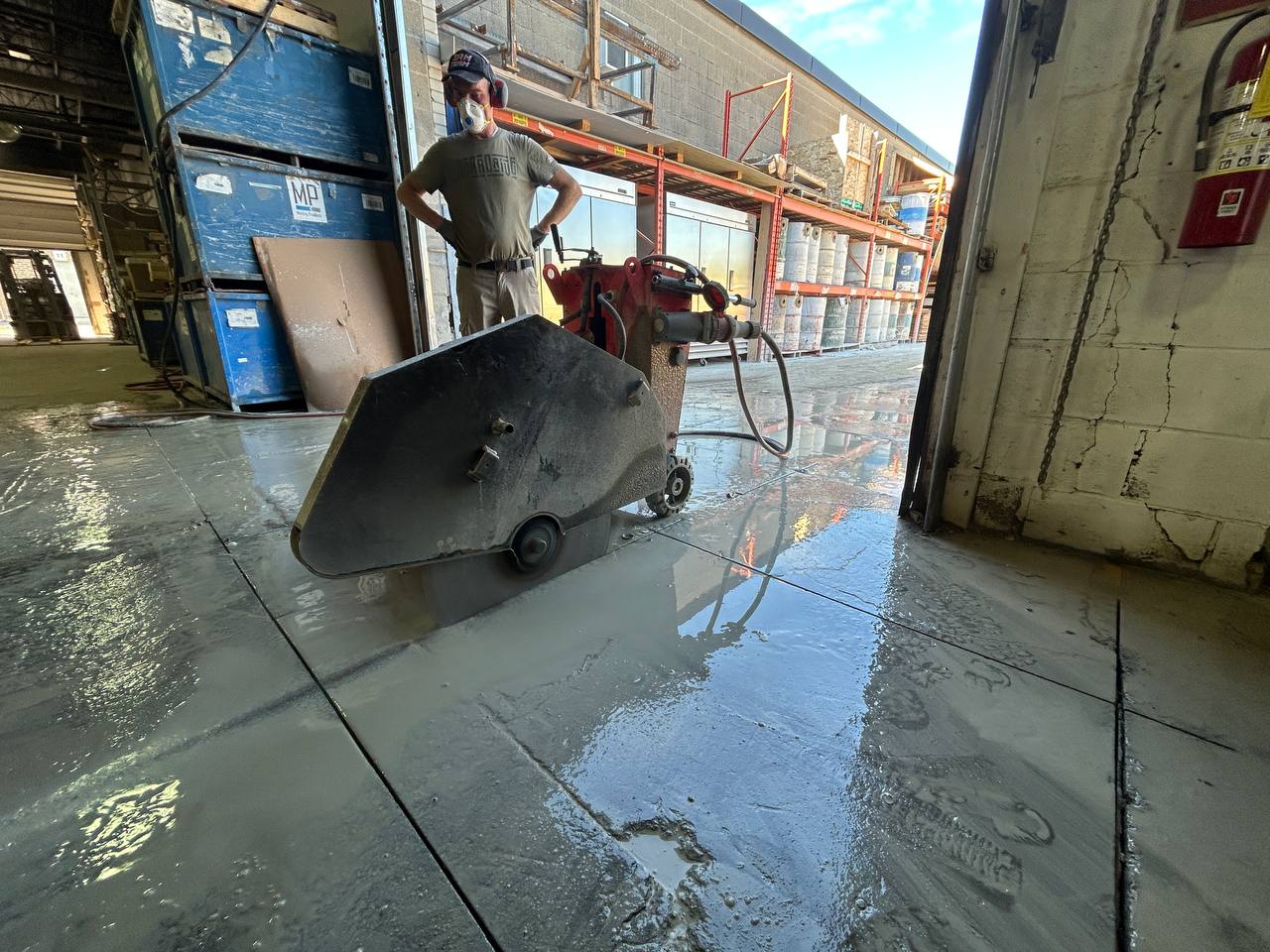
The cut is controlled, but the dust tail comes from:
- carts rolling through residue
- workers walking through wet fines and tracking out
- dried edges after the shift
Control priorities:
- define a clean path (plywood if needed)
- wet vac + squeegee rhythm (don’t let it build up)
- treat patch/restore as part of turnover if required (fast-set materials where reopening is tight)
4.3 Core drilling indoors (generally controlled, but don’t ignore residues)
Core drilling is usually low dust with water, but the “miss” is:
- slurry around the hole
- cleaning holes dry
- uncontrolled run-off on finished floors
OSHA’s Table 1 language highlights that, for certain drill tasks, using HEPA-filtered vacuums for cleanup/holes is part of the specified method set.
Even when you’re not operating under OSHA jurisdiction, the logic is sound: don’t turn wet residue into dry dust.
4.4 Wire sawing indoors (low vibration, controlled dust—but heavy slurry)
Wire sawing usually has minimal airborne dust at the cut line (wet process), but it creates:
- significant slurry volume
- housekeeping pressure under tight windows
- risk of dried fines if cleanup isn’t disciplined
Control priorities:
- isolate and collect early
- keep slurry from migrating into corridors/equipment zones
- bucket/seal solids so they don’t dry out on the floor
4.5 Chipping (the dust tail generator)
Chipping is the real threat indoors because it’s often added as “small finishing.”
If it must happen:
- keep it minimal and localized
- treat it as a separate risk task with its own micro-containment and cleanup rhythm
- never finish the shift with dry residue on surfaces that will see traffic
5) Case snapshots (proof that the system works)
Case #1 — Food production (weekend window, high cleanliness expectations)
Client environment: packaged food production.
Constraint: strict cleanliness + limited operating window (weekends).
Approach: isolate with poly walls, wet cutting, continuous wet-vac cleanup, sealed solids removal.
Outcome: openings expanded and area turned back clean for production restart—without migrating dust into adjacent zones.
Case #2 — Food Basics overnight trenching (operations resume at opening)
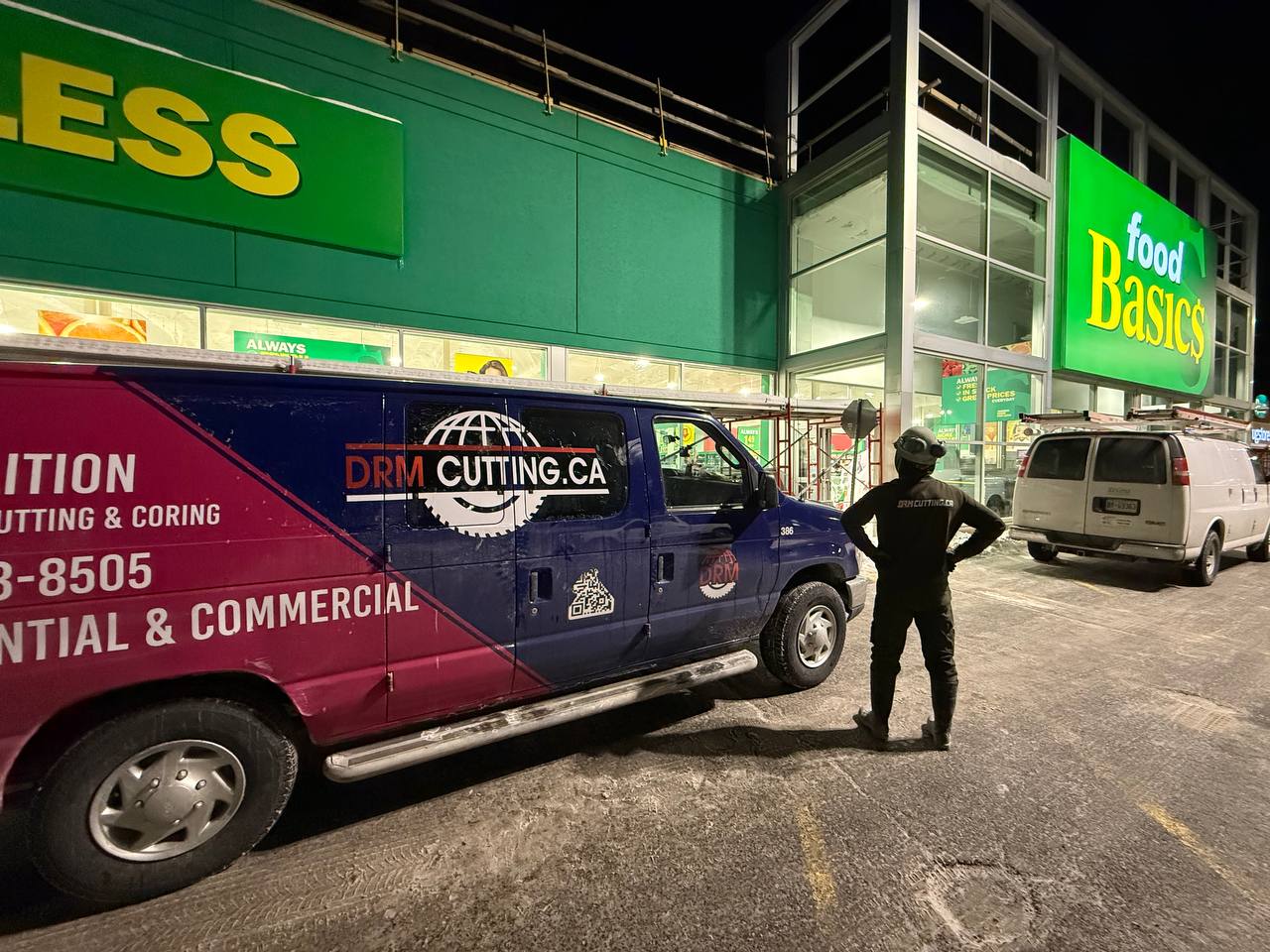
Location: Ottawa (retail grocery).
Scope: ~80 ft trenching in slab for electrical runs to self-checkout.
Crew: 2. Window: one night / one shift.
Constraint: store must reopen with a clean, ready floor around products and public traffic.
Approach: scan → wet cut → remove → clean turnover → fast-set patch/restore.
Outcome: floor ready before morning opening; operations resumed on schedule.
Case #3 — Sunny Food (controlled indoor work near production)
Constraint: sensitive, cleanliness-driven interior and weekend-only access.
Approach: poly containment where required, wet cutting discipline, wet vac housekeeping, sealed solids.
Outcome: scope completed inside the allowed window with clean turnover.
6) Estimator checklist (what to ask so the dust plan is real)
Ask these before you price an indoor cut:
- Sensitivity level: occupied / electronics / food / healthcare / public corridors
- Operating windows: nights / weekends / “must reopen by X”
- Containment requirement: yes/no; how strict; who provides poly/zip doors if needed
- Drain rules: is liquid discharge allowed; are solids prohibited from drain
- Turnover standard: construction-clean vs operations-clean
- Any chipping/finishing expected? (this drives the dust tail)
- Haul-out route: avoid tracking residue through active areas
- Documentation: any exposure control plan required by site or GC
7) Practical close: what we recommend before mobilization
On sensitive indoor scopes, we start with a site walk + a short verification scan where scope warrants (to confirm thickness/rebar routes and build the right sequencing and housekeeping plan). The goal is simple: no surprises, no migration, clean turnover inside the allowed window.
Indoor Concrete Cutting Dust Control — FAQ
Search-intent answers on silica, wet cutting, containment, slurry handling, and cleanup for indoor concrete cutting dust control.