
How We Remove Concrete in Live Facilities (Plants, Banks, Airports) Without Stopping Operations
A practical engineering playbook for limited access + sensitive sites, built around Diamond Wire Cutting and zero-shutdown sequencing
Abstract
“Concrete removal in a live facility” is rarely a cutting problem. It’s a continuity-of-operations problem under real constraints: passenger flow, production schedules, sensitive equipment, dust limits, noise/vibration tolerance, security, and short work windows. This article explains a field-ready approach we use to remove reinforced concrete without full shutdowns: constraint mapping, “no-blind-cuts” verification, wet cutting with slurry control, segmentation math sized for safe handling, and haul-out sequencing that finishes before operations resume.

1) What “without stopping operations” really means on real sites
In practice, “operations” usually means one (or several) of these must keep running:
- Passenger flow (GO / metro / station environments) where the building is live during the day and you get a tight night window.
- Production flow (plants) where downtime is costly and scheduling is rigid.
- Security zones (banks/airports) with restricted access routes and strict site rules.
- Sensitive equipment areas (mechanical/electrical rooms, controls, servers) where vibration, dust, and water risk are the job.
On many projects, the facility allows only localized isolation: you can close a small zone (plastic “box,” hoarding, controlled access), but the rest of the building must function normally.
2) Why downtime is the most expensive risk (even when it’s not on your scope sheet)
If you’re estimating live-facility work, the owner’s first priority is usually: avoid operational disruption.
- Siemens’ 2024 downtime analysis reports that one hour of downtime in a large automotive plant costs about $2.3M per hour.
- The same Siemens report is cited by ISM as showing unscheduled downtime draining ~11% of annual revenues across the world’s 500 biggest companies (aggregate framing—useful to explain why “no shutdown” rules exist).
- In aviation-adjacent environments, Airlines for America reports the average 2024 aircraft block-time cost was $100.76 per minute—a proxy for why airport work frequently comes with strict windows and disruption intolerance.
Estimator takeaway: “Cheap demo” is irrelevant if it triggers shutdowns, passenger disruption, alarms, or safety stoppages. The winning plan is the one that stays inside the facility’s operating envelope.
3) The constraint map: dust, noise, vibration, alarms, access
Live facilities restrict methods because the risks are measurable.
3.1 Dust / silica: wet methods aren’t optional in many live environments
Respirable crystalline silica is a core driver behind wet methods and containment. OSHA’s silica standard sets a PEL of 50 μg/m³ (8-hour TWA).
Even when you’re working under Canadian rules, the industrial hygiene reality is the same: uncontrolled dust becomes a stop-work risk.
Why wet cutting is the default:
A controlled study on concrete saw cutting reported wet cutting reduced respirable dust concentration by ~85% vs dry cutting in paired tests.
NIOSH guidance also recommends wet methods and water sprays to suppress silica dust.
3.2 Noise: live sites often require “no impact demo”
Ontario’s noise regulation framework (O. Reg. 381/15) is built around an 85 dBA Lex,8 exposure concept and the need to protect workers from hazardous sound levels.
That’s before you even address tenant complaints, hotel guests, or adjacent operating units. In mixed-use buildings, we often get night windows specifically to keep noise low.
3.3 Vibration: not just comfort—equipment and operations risk
Hand-arm vibration exposure thresholds commonly referenced in safety guidance include an Exposure Action Value of 2.5 m/s² A(8) and an Exposure Limit Value of 5.0 m/s² A(8).
This is one reason impact-heavy tools (breakers) are often rejected indoors—especially near sensitive equipment or in older structures.
3.4 Alarms and “no gasoline smell” constraints
Many live facilities care less about “sparks” and more about alarm triggers (smoke/odor) and complaints. On indoor work, we avoid gasoline cut-off saws when possible and prioritize electric/hydraulic cutting, because odor and exhaust can linger and can trigger facility responses.
4) Method selection: when Diamond Wire Cutting is the safest path indoors
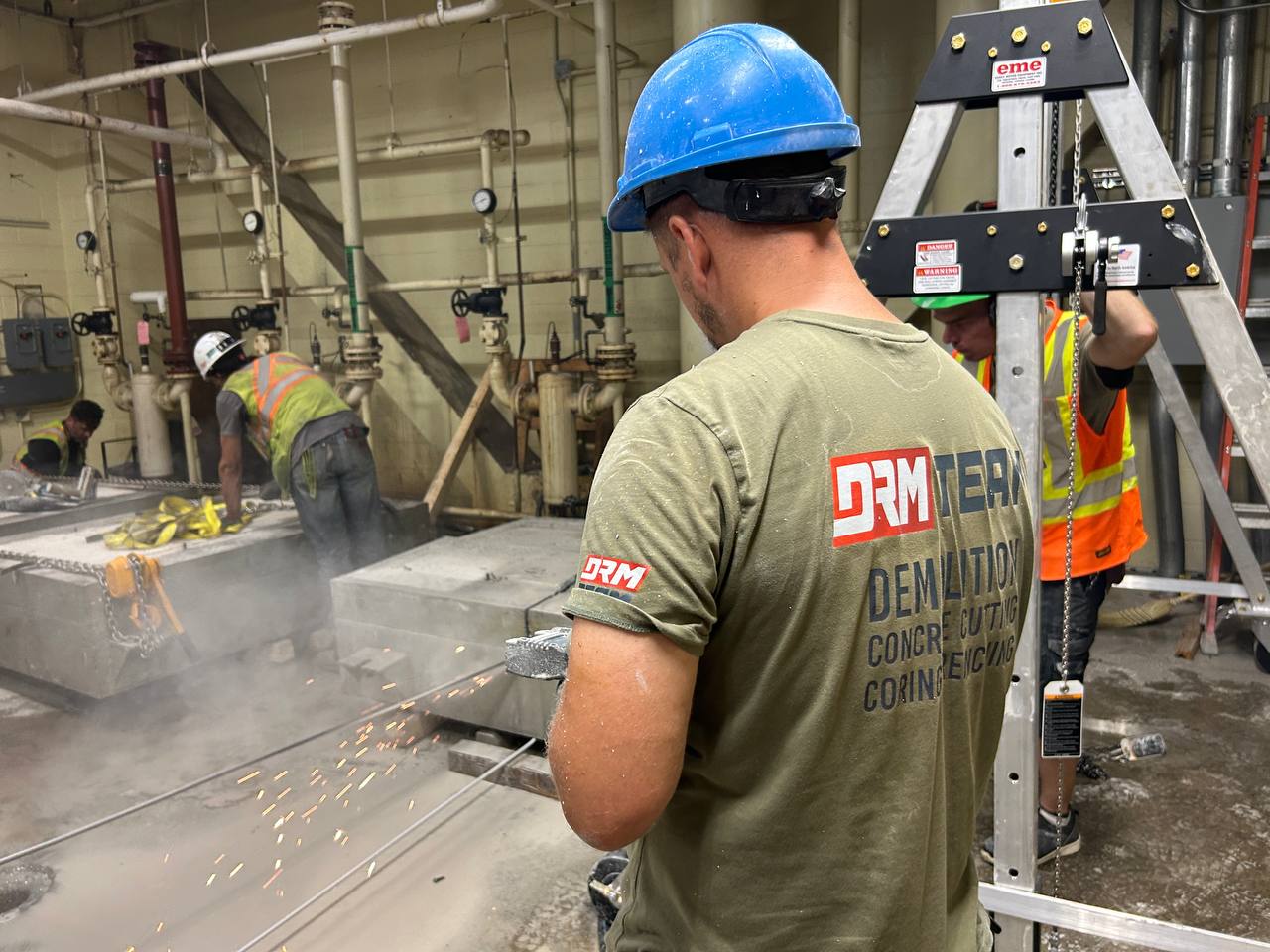
Diamond Wire Cutting (wire sawing) becomes the method of choice when one or more of these conditions are true:
- concrete is too thick or too heavily reinforced for efficient saw-only removal
- embedded steel is likely (plates/rails/heavy bar)
- the structure must be removed in engineered segments to control haul-out and avoid impact demo
- access is limited and the plan must work with pallet jacks, dollies, skates, chain falls, or occasional forklift/skid steer (where permitted)
In practice, live-facility work is often a stack, not a single tool:
- wire sawing (diamond wire cutting)
- coring (starter holes / pass-throughs / rigging points)
- floor/wall saws for layout cuts and clean edges
- scanning (“no-blind-cuts”) to reduce surprises
5) “No-Blind-Cuts” verification: the fastest way to reduce change orders and delays
In live facilities, unknowns cost time and create stoppages. Verification focuses on:
- thickness confirmation in a test zone when drawings are uncertain
- rebar layout and density (planning tool wear + sequence)
- embedded steel risk (plates/rails)
- plausible utilities (where applicable)
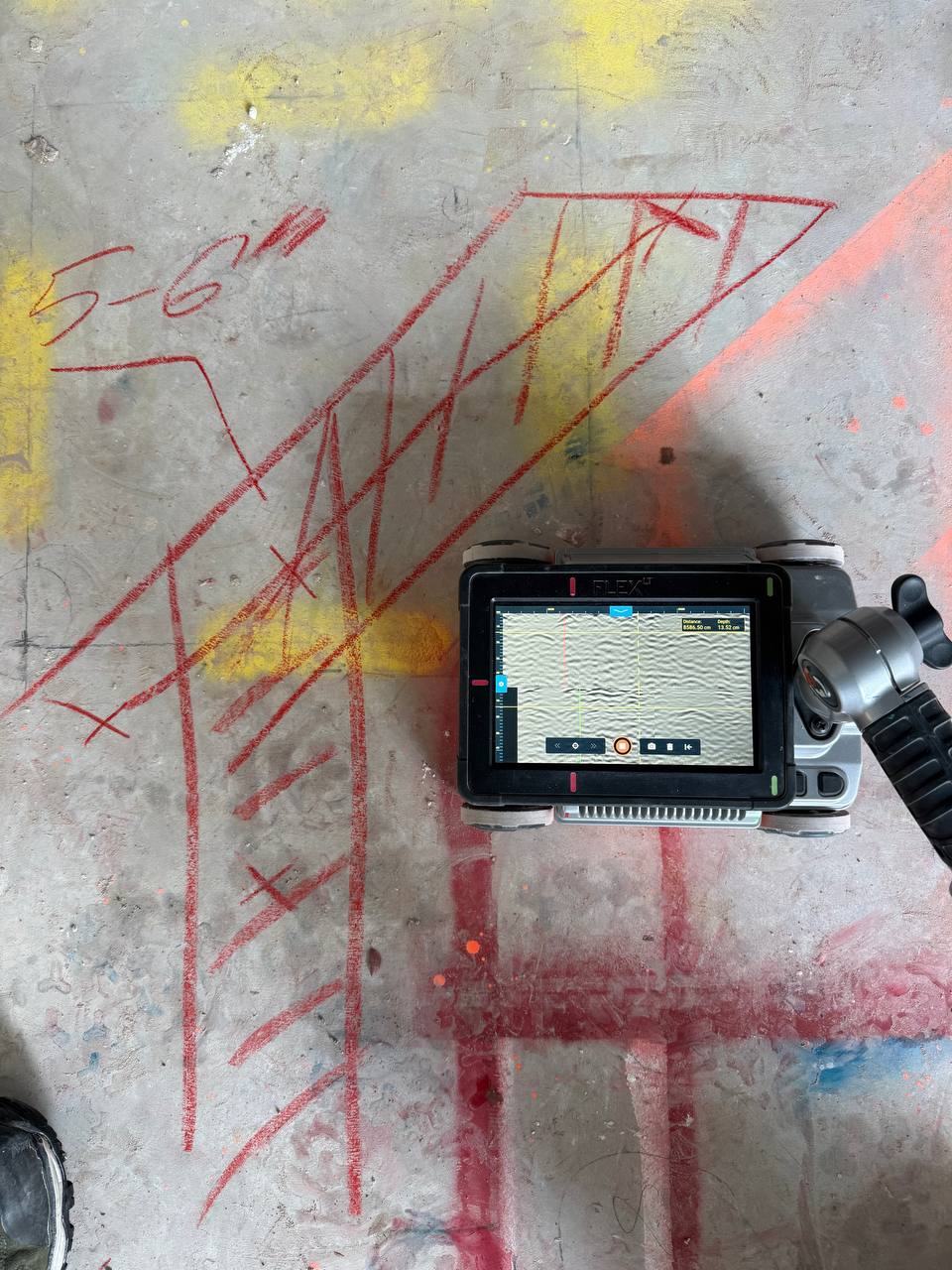
From a commercial standpoint, our heavy-job entry step is often an expert site visit + targeted GPR scan to confirm thickness, reinforcement, and hidden risks before locking the demolition method.
6) Segmentation math: the project is not “cutting”—it’s controllable handling
The most common live-site failure mode is simple: the piece is cut… and then it can’t be moved safely or quickly.
6.1 The mass calculation we use to size pieces
We size segments using volume and unit weight.
Typical density ranges for normal concrete are commonly cited around 2240–2400 kg/m³ (140–150 lb/ft³).
Rule of thumb used for planning:
- for rough estimating, 150 lb/ft³ is a useful baseline
- we adjust if the element is heavily reinforced or includes embedded steel
Formula:
- Mass (lb) = Volume (ft³) × Unit weight (lb/ft³)
- Mass (kg) = Volume (m³) × Density (kg/m³)
6.2 What actually controls segment size indoors
Segment size is a balance of constraints:
- Haul-out geometry: tight corridors, elevator limits, turns, staging nodes
- Allowed handling tools: dollies, pallet jack, skates, chain fall, overhead beam, occasional forklift/skid steer
- Attachment method: anchors + lifting eyes, through-cores, rigging strategy
- Floor loading / protection: plywood, mats, plates as needed
- Cost of extra cuts: more grid cuts increase time, wear, slurry handling
Typical “sweet spot” for controlled indoor segments (when you need safe manual/compact handling) often lands in a few hundred kilograms—heavy enough to be efficient, light enough to move without cranes (site-dependent).
7) Wet cutting → slurry: managing the trade-off safely
Wet cutting is a dust-control win, but slurry must be planned.
Concrete wastewater can be highly alkaline—one municipal guidance document states concrete wastewater can reach pH 12–13.
Industry environmental guidance for ready-mix and slurry handling notes wastewater contacting concrete/cement becomes more alkaline and often requires treatment/controls.
Our practical live-site approach:
- capture liquids (vacuum/containment)
- discharge only where the facility authorizes (site-specific)
- collect heavy slurry/solids into sealed containers (often buckets), then remove with the concrete waste stream
8) Sequencing in live facilities: finish before operations restart
The sequencing model that works most often:
- Pre-mark + verify (scan, thickness check, route check)
- Contain (plastic “box” / controlled door, floor protection)
- Cut wet (diamond tools; avoid impact methods)
- Segment → remove in a predictable haul-out rhythm
- Final clean + reset before the window closes
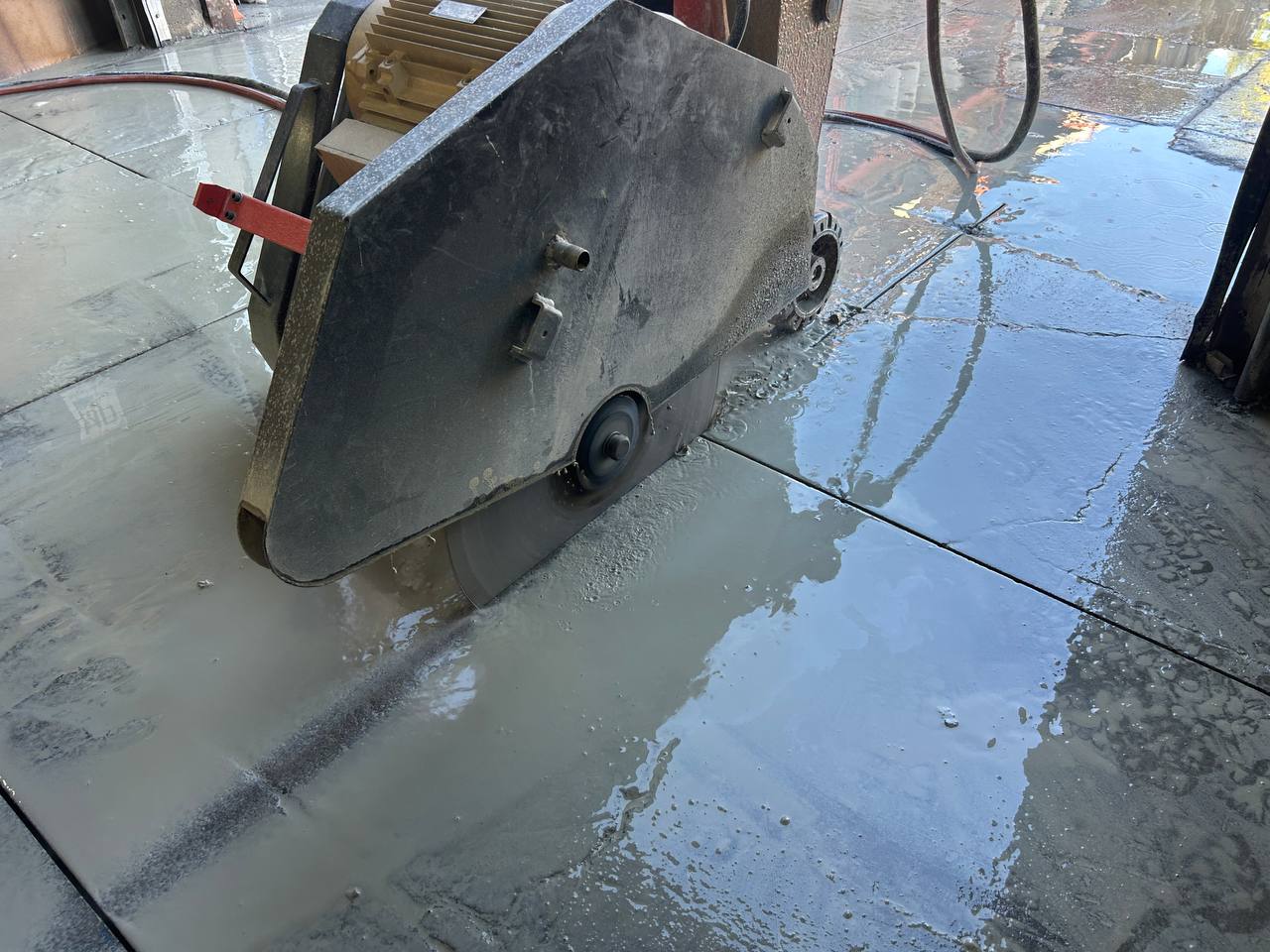
This is the difference between “we cut a lot” and “we left the facility ready for morning operations.”
9) Case snapshot #1 — GO station night-window trenching (passenger flow constraint)
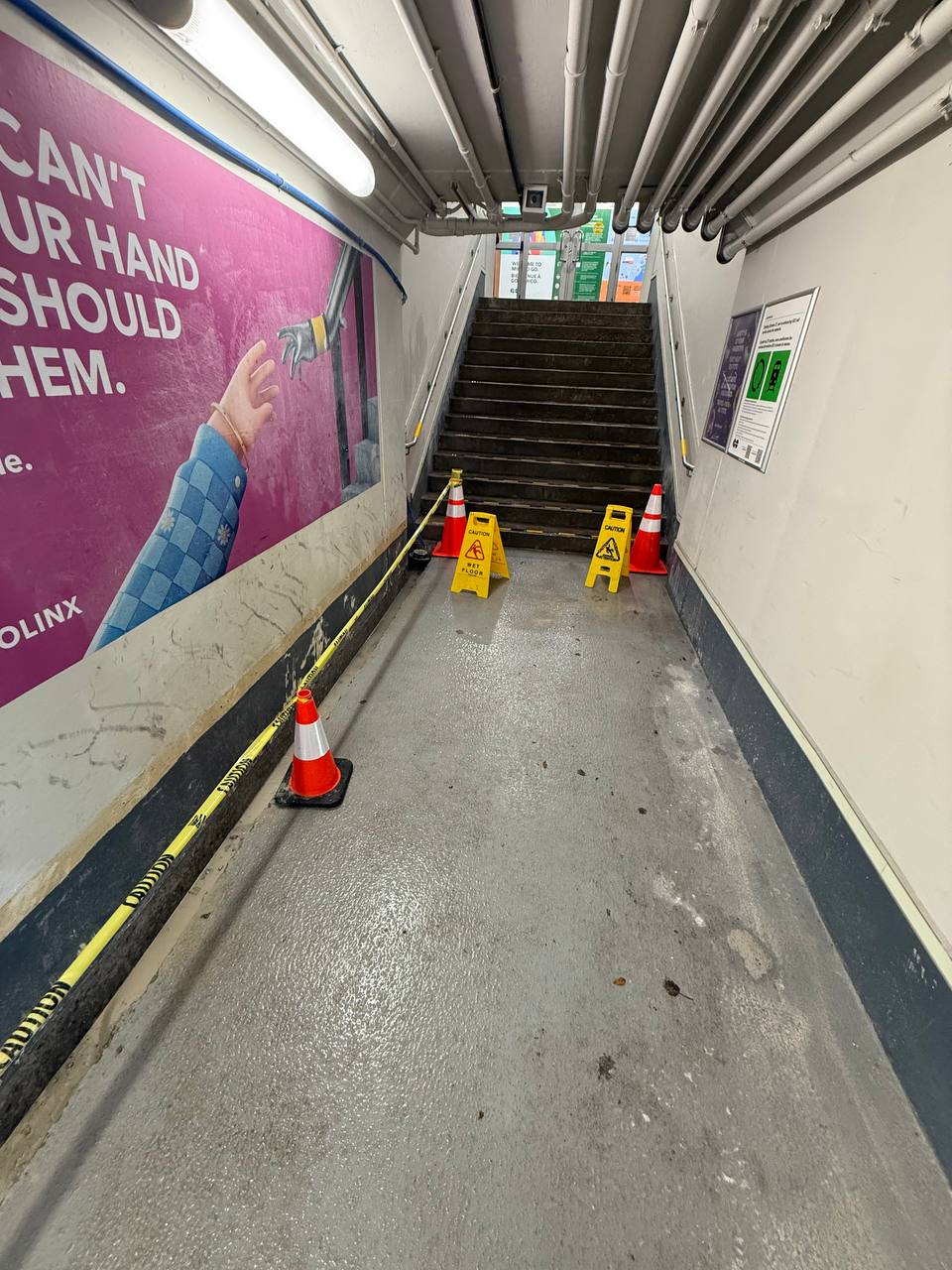
Site type: active transit station (passenger operations during the day)
Constraint: work window between last/first trains; 00:00–05:00 night access
Crew: 3 people
Duration: 3 night shifts
Work performed: trenching / floor saw cutting in a tunnel-grade slab with heavy reinforcement
9.1 Scope numbers (converted to feet/inches for estimating)
- Trench length: 150 m ≈ 492 ft
- Trench cross-section (approx.): 8 in × 8 in
- Window logic: every night, the job had to end with all concrete removed and full cleanup completed before morning flow.
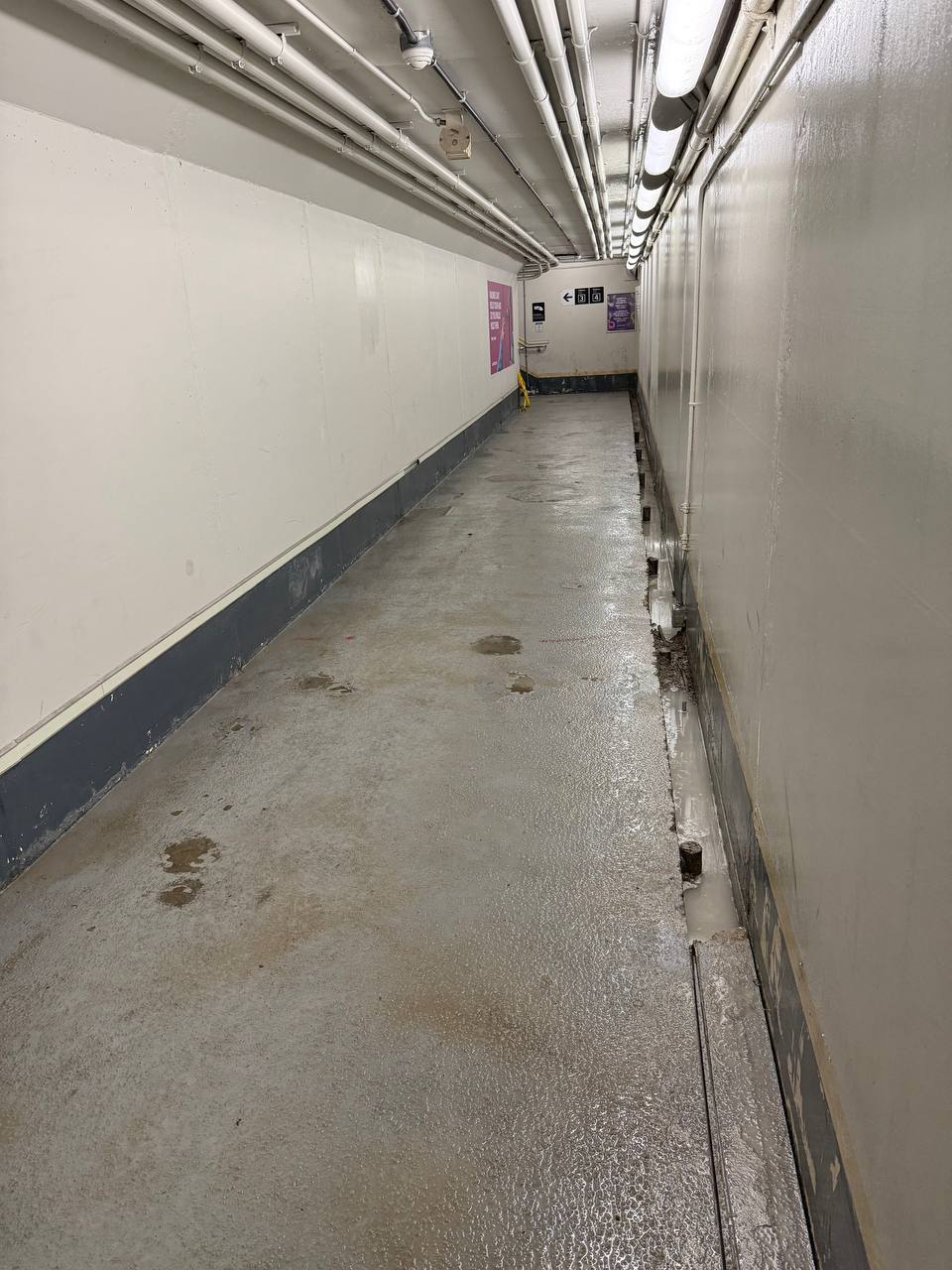
9.2 What that volume implies (useful estimating math)
If you model the trench as a rectangular prism:
- Volume ≈ 492 ft × (0.667 ft) × (0.667 ft) ≈ 219 ft³
- In cubic yards: 219 ft³ ÷ 27 ≈ 8.1 yd³
- Using 150 lb/ft³: 219 × 150 ≈ 32,800 lb ≈ 14.9 metric tonnes (order-of-magnitude estimate)
Why this matters: the plan is not “cut it.” The plan is cut + break down + remove + clean inside a five-hour window—repeated across nights, without disrupting morning operations.
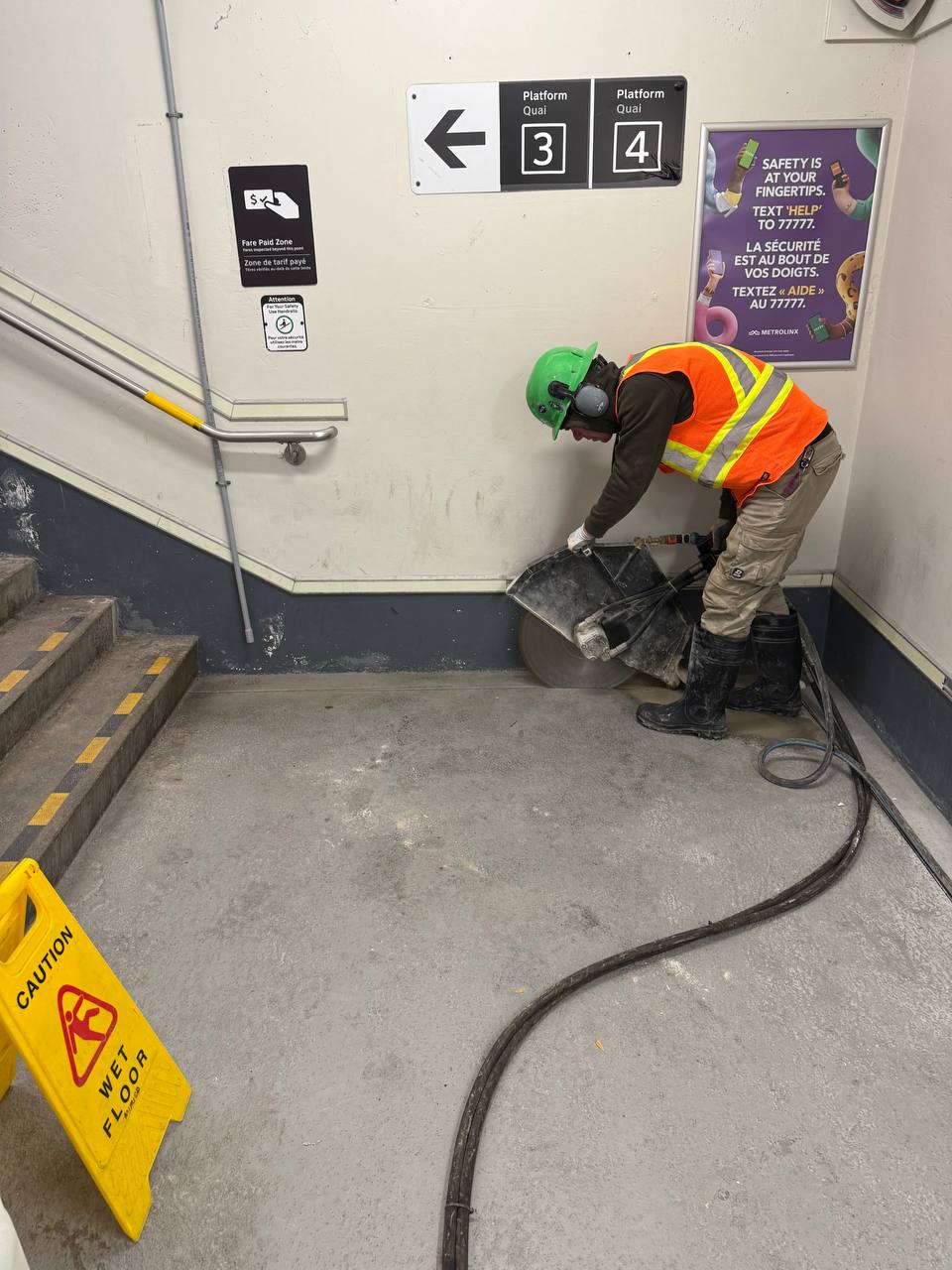
9.3 Execution logic that makes the window realistic
- wet cutting to minimize airborne dust (silica control)
- tight zone management and a haul-out rhythm that matches the access route
- cleanup treated as a deliverable, not an afterthought
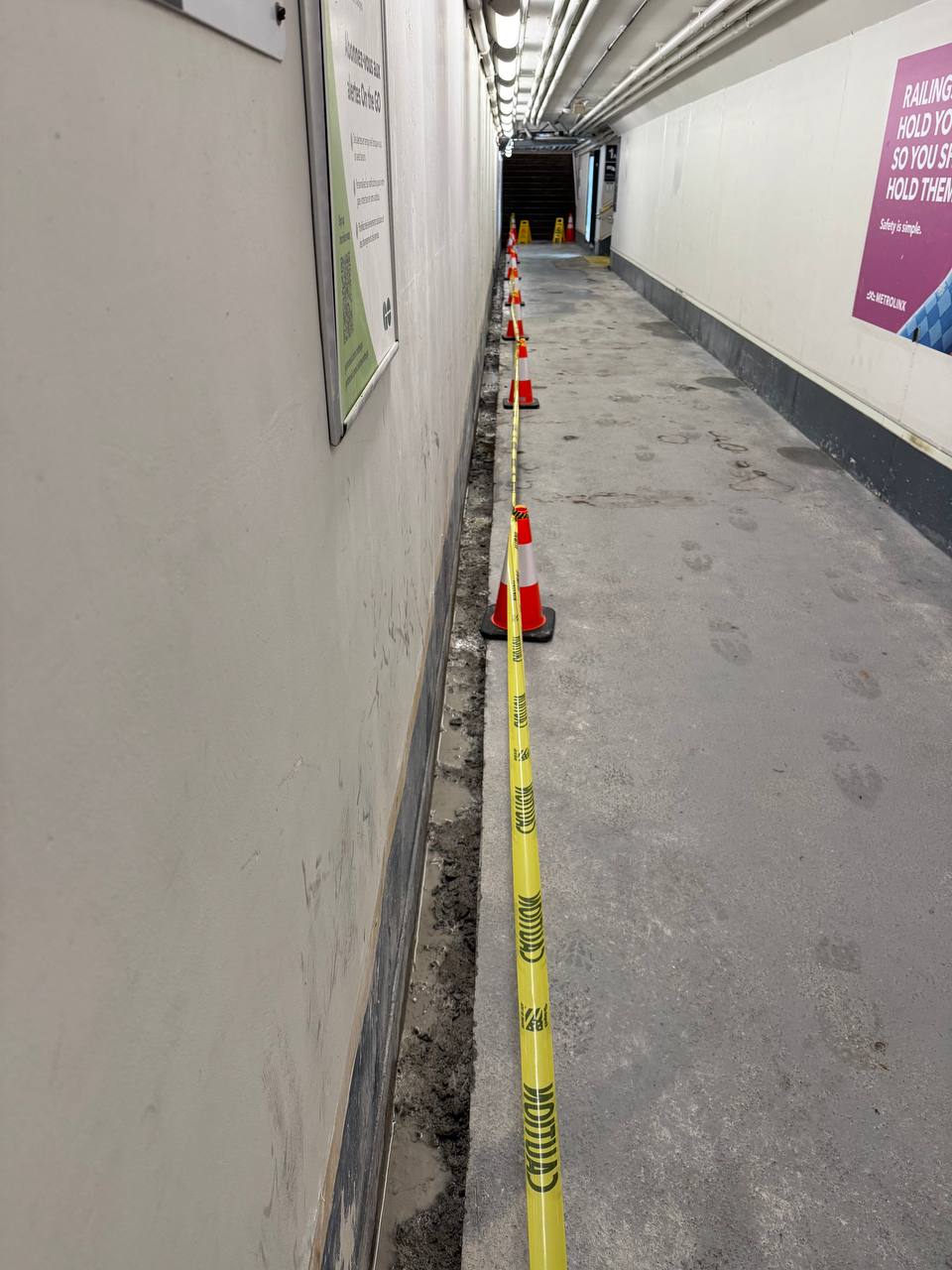
Outcome: operations resumed normally each morning with the work area restored.
10) Case snapshot #2 — Mechanical room opening expansion (zero-vibration / zero-dust mindset)
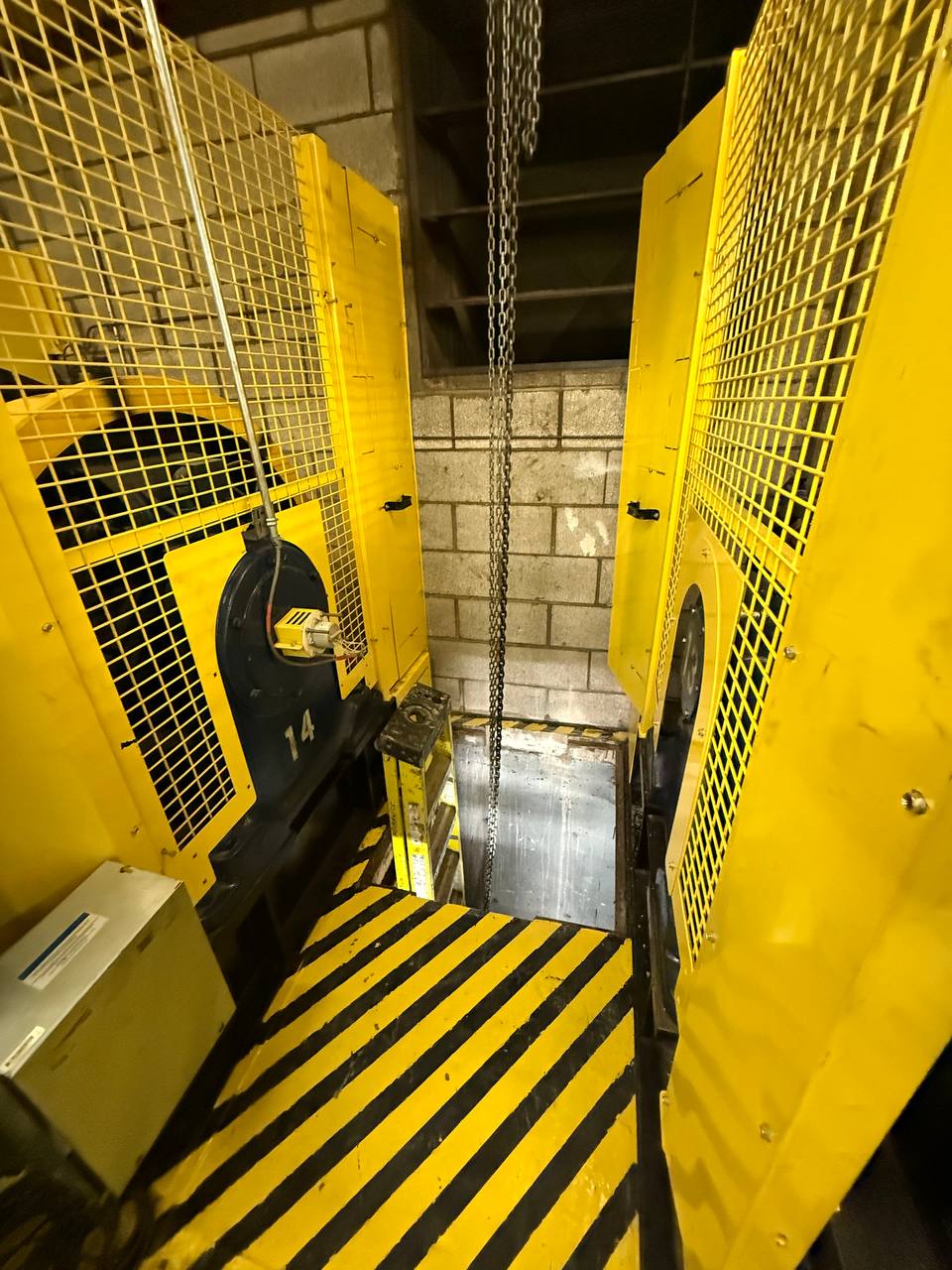
Site type: sensitive mechanical room environment in a downtown hotel setting (guest/tenant noise sensitivity + critical equipment nearby)
Constraint: minimal noise + minimal vibration + no dust; strict timing approved by management
Crew: 2 people
Duration: ~6 hours
Concrete thickness: ~6 in (site-reported)
Segment handling: small sections, total removed mass on the order of ~60 kg (132 lb) for the concrete removed
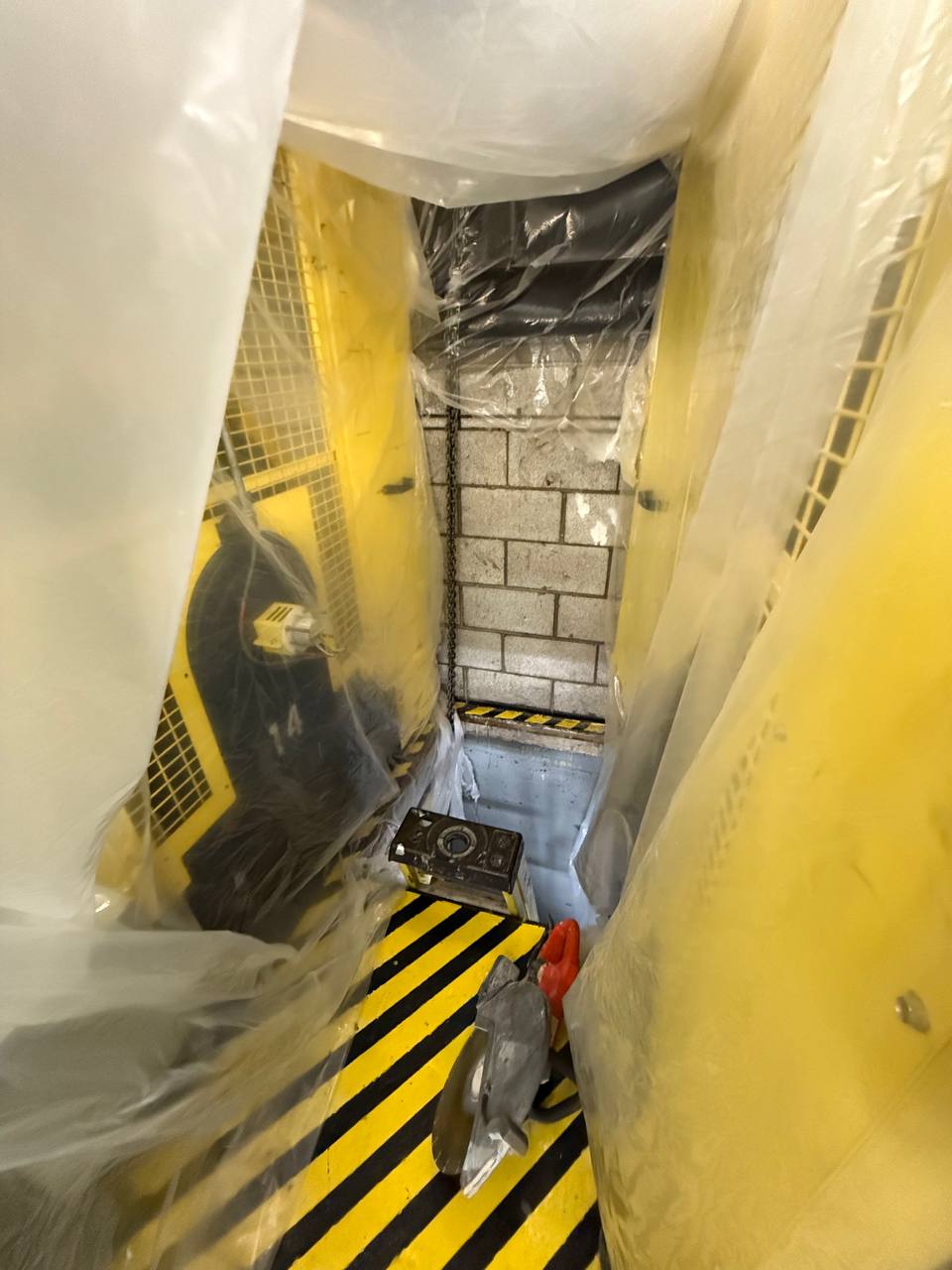
Why this job is “live facility” even when the quantity is small
This was not about cutting power. It was about risk control:
- sensitive equipment nearby (controls / electronics)
- dust and water management in a confined room
- schedule discipline: arrive on time, execute, restore
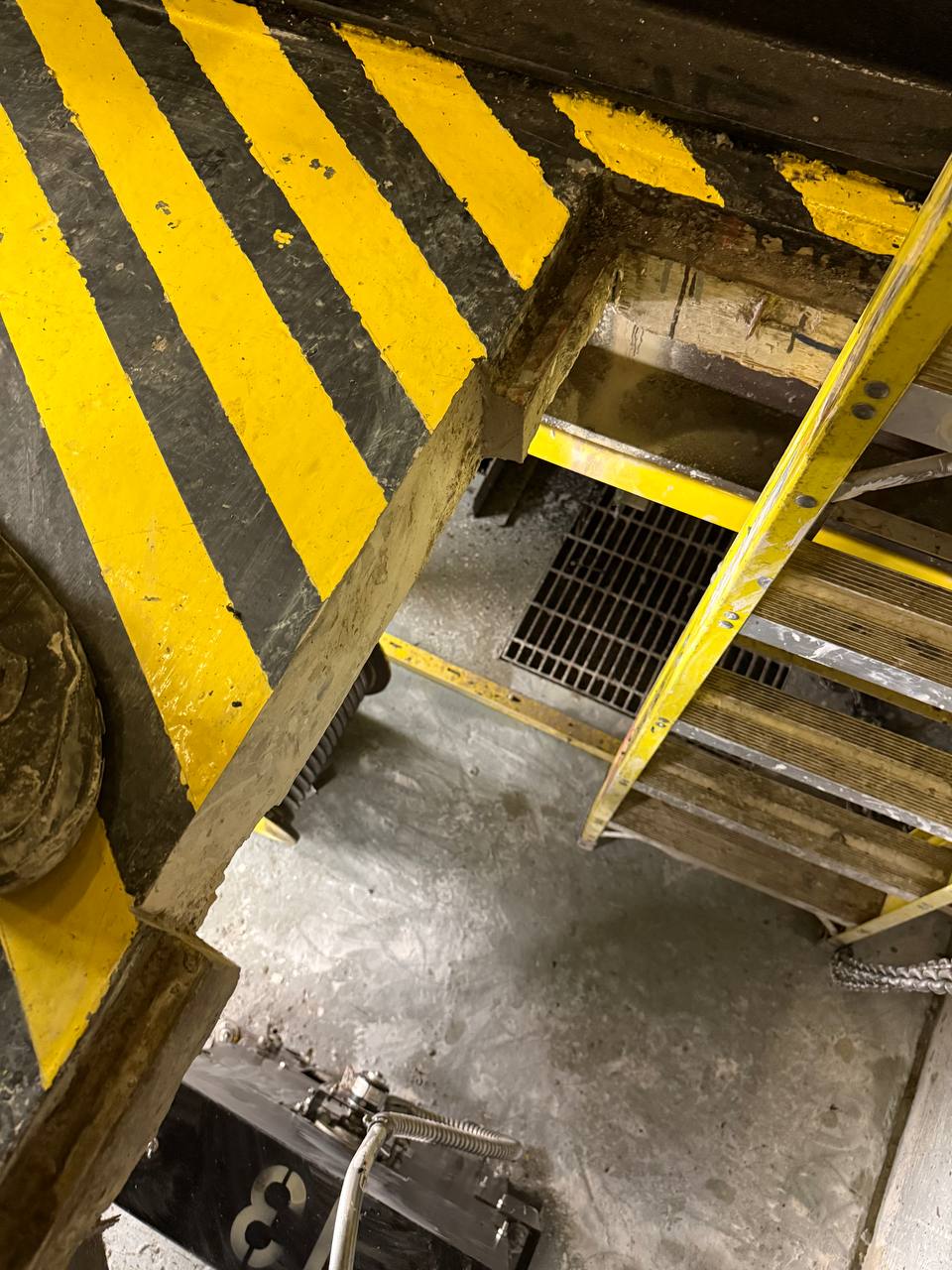
Outcome: controlled removal completed inside the approved window with the room returned clean.
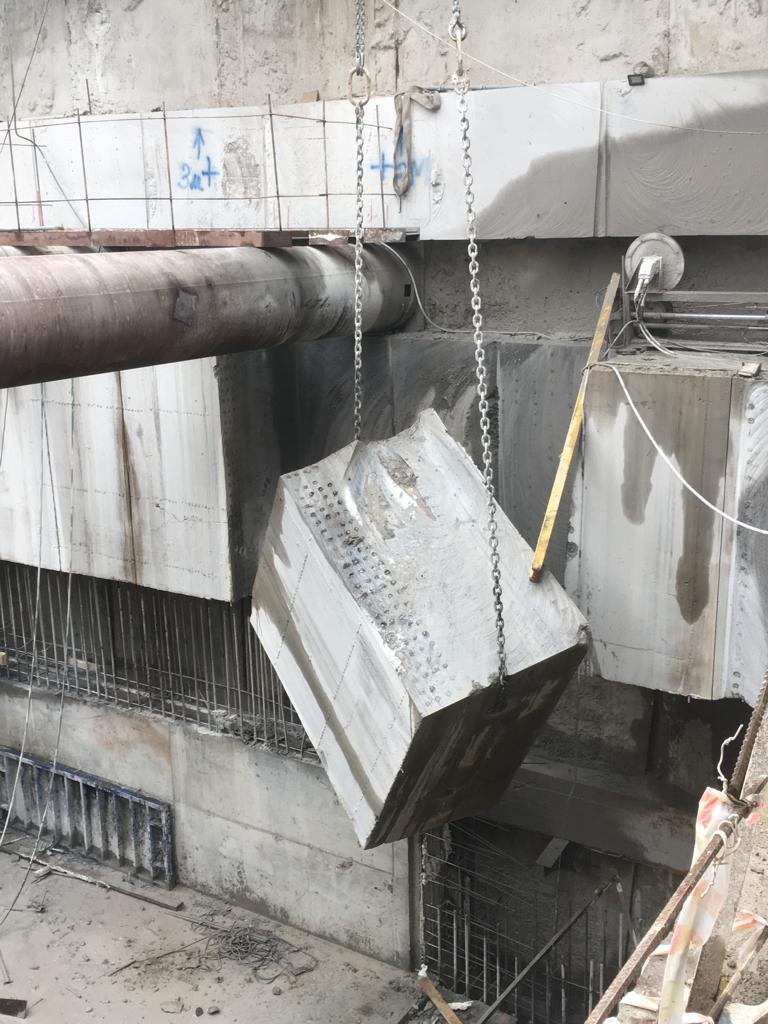
11) Case snapshot #3 — Airport mechanical-room foundation removal (second floor) without vibration or shutdowns
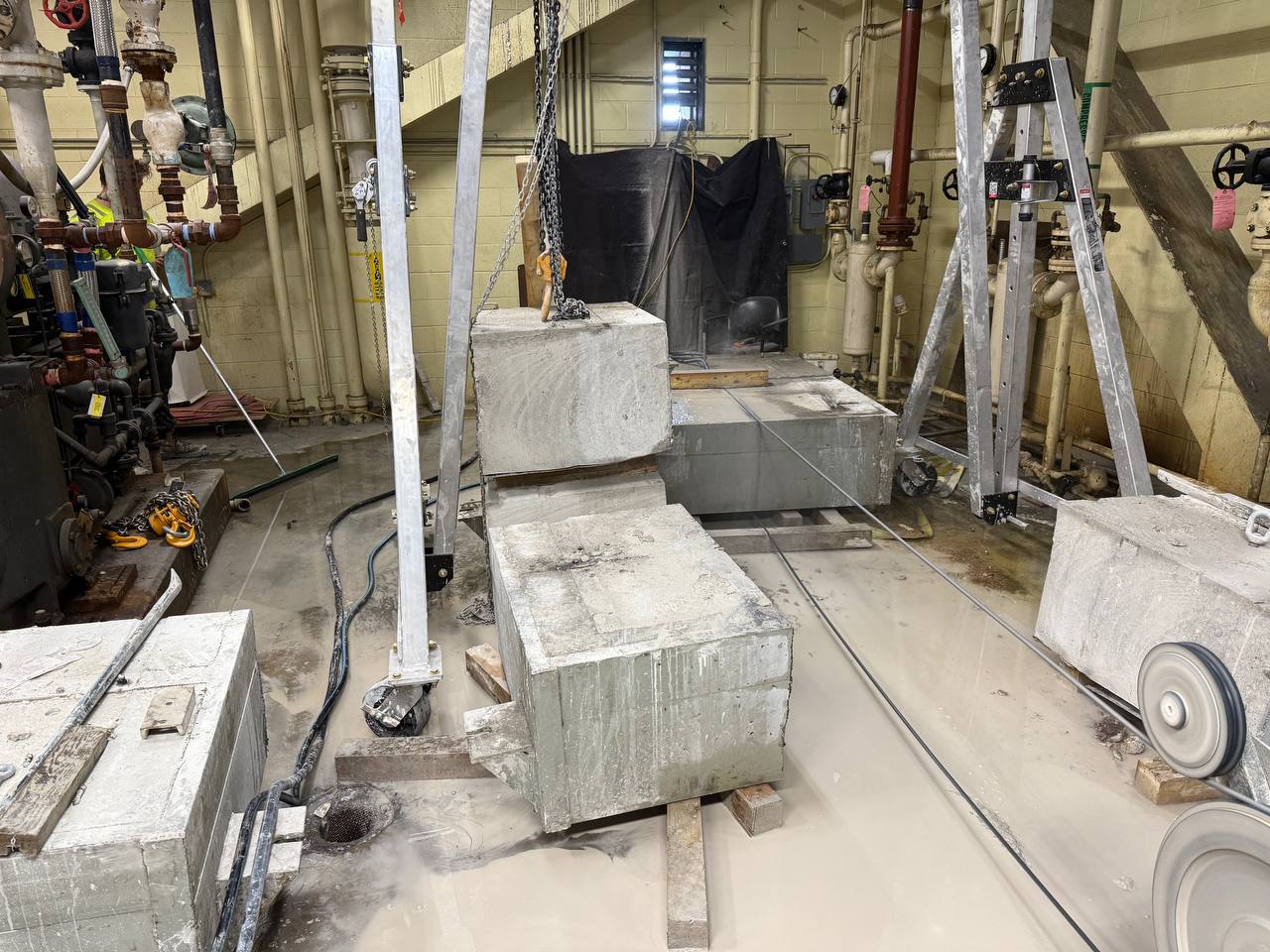
Site type: airport (mechanical room), second floor
Operational constraint: live facility with sensitive equipment nearby; work had to be executed with minimal vibration and controlled noise, with strict routing/logistics due to limited access.
Scope (focus on Diamond Wire Cutting):
- Removed three equipment foundations using Diamond Wire Cutting (wire sawing).
- (Additional scope on the same site included two smaller foundations removed with diamond saw cutting, but the case below focuses on the wire-sawn foundations due to thickness and vibration constraints.)
Work window: 3 day shifts over 3 days (approx. 9:00 AM–5:00 PM)
Primary limitations:
- No impact demolition (no excavator/mini-excavator with breaker).
- Mandatory verification: the area required scanning/verification to avoid damaging embedded services/communications (“no-blind-cuts” discipline).
- Tight logistics on an upper floor: all handling and removal had to follow a controlled route and staging plan.
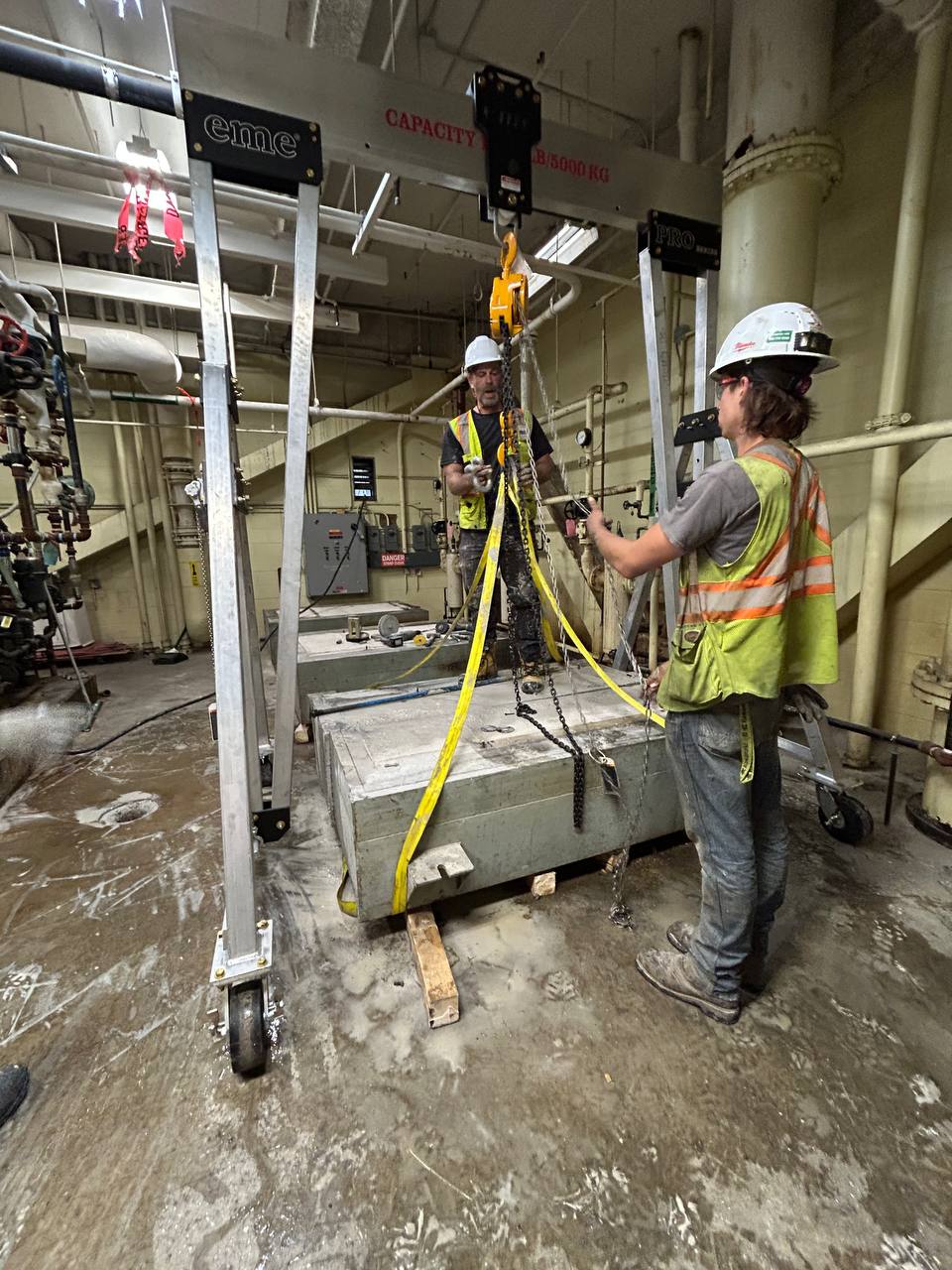
Geometry + segmentation plan (what made the job possible indoors)
Foundation thickness: 2 ft (24 in)
Segmentation size: each foundation was cut into 4 blocks, each block sized at 2 ft × 2 ft × 3 ft.
That yields:
- Blocks per foundation: 4
- Total blocks (3 foundations): 12
Mass math (why segmentation is the job)
Block volume:
- 2 ft × 2 ft × 3 ft = 12 ft³ (≈ 0.340 m³)
Using a conservative reinforced-concrete planning density of ~2,500 kg/m³, estimated block mass:
- 0.340 m³ × 2,500 kg/m³ ≈ 850 kg (≈ 1,870 lb) per block
Total estimated mass removed (wire-sawn foundations):
- 12 blocks × 850 kg ≈ 10,200 kg ≈ 10.2 metric tonnes (order-of-magnitude estimate)
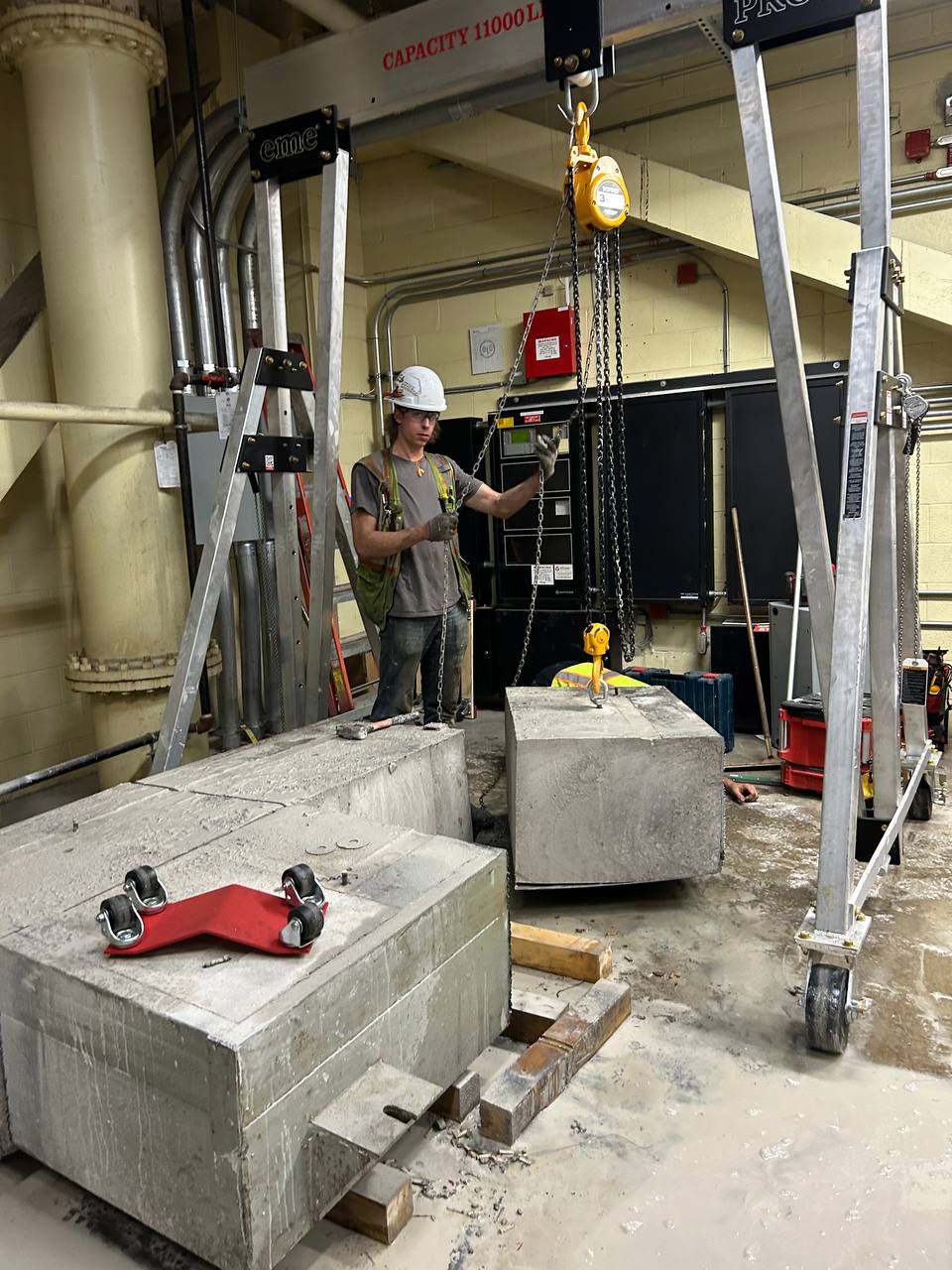
Execution sequence (live-facility logic)
- Verify + mark (“no-blind-cuts”): confirm the element boundaries and scan to avoid embedded services.
- Wet cutting + controlled slurry handling: reduce airborne dust and keep the work area manageable in a sensitive room.
- Diamond Wire Cutting segmentation: cut the 2-ft-thick foundations into predictable riggable blocks sized for controlled handling on an upper floor.
- Controlled haul-out + cleanup: remove blocks through the planned route, maintain housekeeping, and restore the space for continued facility operation.
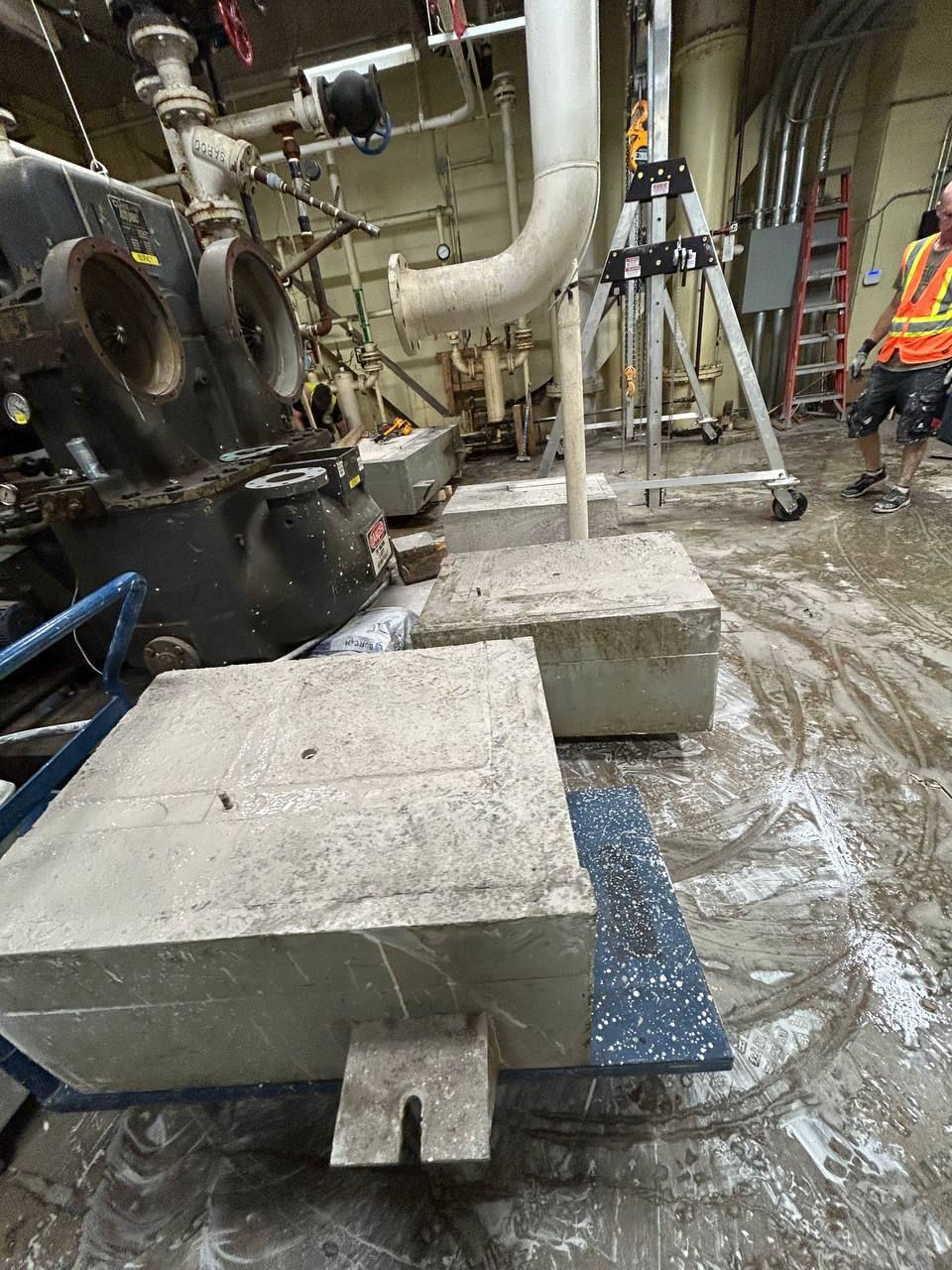
What defined success on this airport site
- Vibration avoided (wire sawing instead of impact methods)
- Predictable block sizing for safe handling and upper-floor logistics
- Controlled dust via wet cutting and disciplined cleanup
- Scope completed within approved daytime shifts without requiring facility shutdowns
12) What estimators should request to price live-facility concrete removal accurately
If you want predictable cost and schedule, request:
Geometry / structure
- thickness range (or permission for test-zone verification)
- reinforcement expectations (heavy rebar, plates/rails, PT presence)
- drawings + photos
Operating constraints
- allowable work windows (e.g., 00:00–05:00)
- “no impact demo” rules (noise/vibration tolerance)
- dust/containment expectations
- alarm sensitivity (odor/exhaust restrictions)
Logistics
- access route map (tightest points)
- elevator and corridor dimensions
- staging space availability
- truck/bin placement and haul distance
Closeout standard
- what “reset” means (washdown, vacuuming, protective coverings removal, etc.)
Technical CTA (estimator-friendly)
For live facilities, the fastest path to a reliable plan is:
- Send drawings + photos + constraints (windows, access, sensitive areas).
- We build a segmentation + haul-out sequence matched to the window.
- If thickness/rebar/embeds are uncertain, we start with an expert walk + targeted GPR test-zone scan to verify assumptions before production cuts.